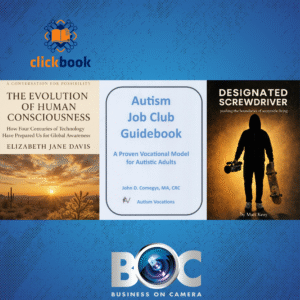
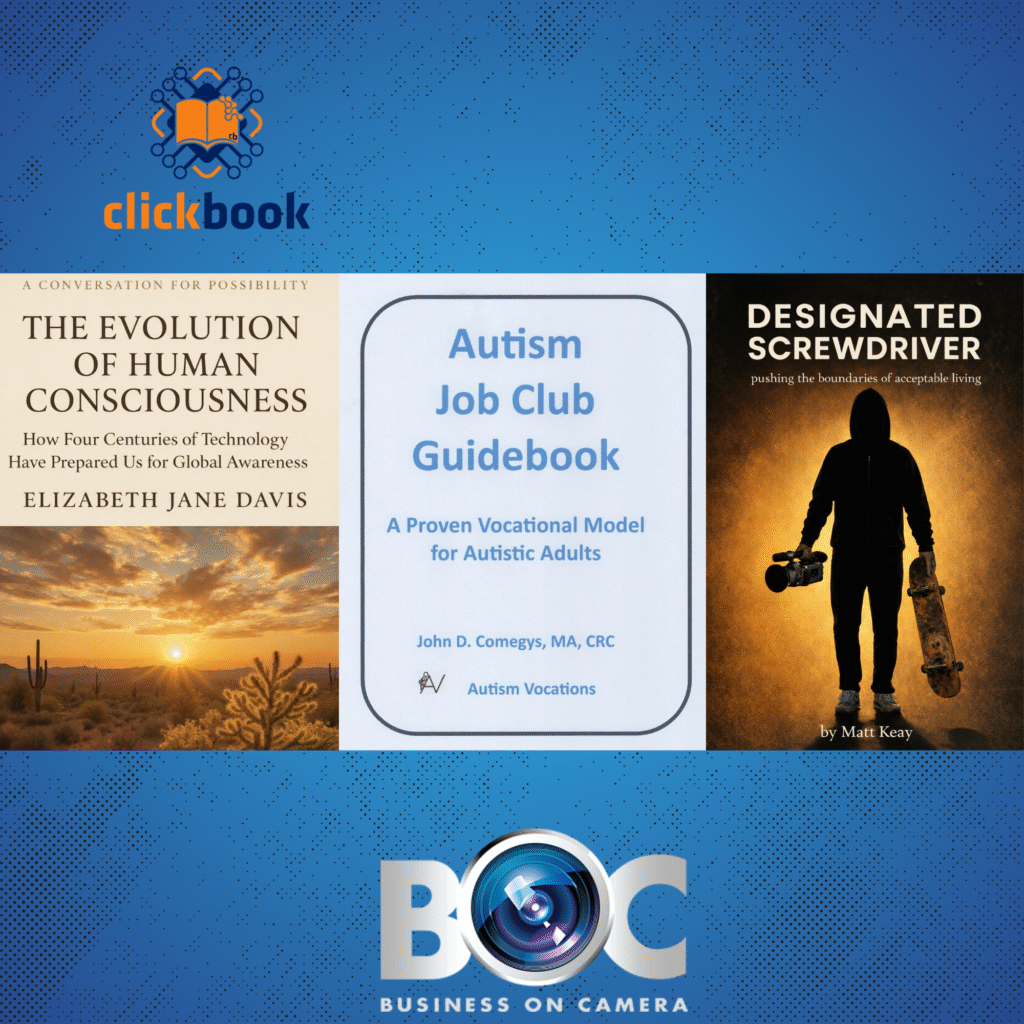
ClickBook, the AI publishing accelerator built by Calgary’s BOC-AI, was created to prove that almost anyone can finish a book in roughly 100 days. Instead of typing drafts alone, writers move through a series of structured voice conversations with an AI agent that captures, organizes, and refines their ideas into a coherent manuscript. A human coach supports each phase with feedback and accountability, while automation handles editing, formatting, and the path to publication. The model is aimed squarely at the writers traditional publishing tends to overlook: seniors, neurodivergent authors, and first-timers. Its closed beta produced a 100% completion rate: three writers started, and all three finished. Here are their books.
John Comegys — The Autism Job Club Guidebook Drawing on more than twenty years in vocational rehabilitation and his own autism diagnosis, Comegys turned a decade of hands-on practice into a working manual. The guidebook lays out a peer-based, facilitator-led model for helping autistic adults find and keep meaningful work. It reads as equal parts professional handbook and personal call to action.
Elizabeth Jane Davis — The Evolution of Human Consciousness Davis traces how four centuries of technology (from the industrial age through electricity, digital networks, and now AI) have reshaped human perception, attention, and identity. Written as observation rather than prediction, the book frames the present moment as a threshold in human development. The result reads less like tech history than a meditation on how we became who we are.
Matt Keay — Designated Screwdriver A raw, darkly funny memoir, Keay’s book braids a turbulent chapter of his past with the larger arc of a life lived at full throttle. It’s a candid, unflinching story of ambition, family, and personal reinvention. It is, fittingly, the founder’s own test drive of the platform he built.
Taken together, the first cohort is the proof ClickBook set out to find. Three writers as different as a vocational-rehabilitation specialist, a big-picture cultural thinker, and a first-time memoirist each finished a complete, publishable book, evidence that the model holds across genres, backgrounds, and experience levels rather than working for one lucky fit. For an Alberta-built platform moving from working prototype toward a market-ready product, that breadth is the clearest signal yet that the approach can scale.